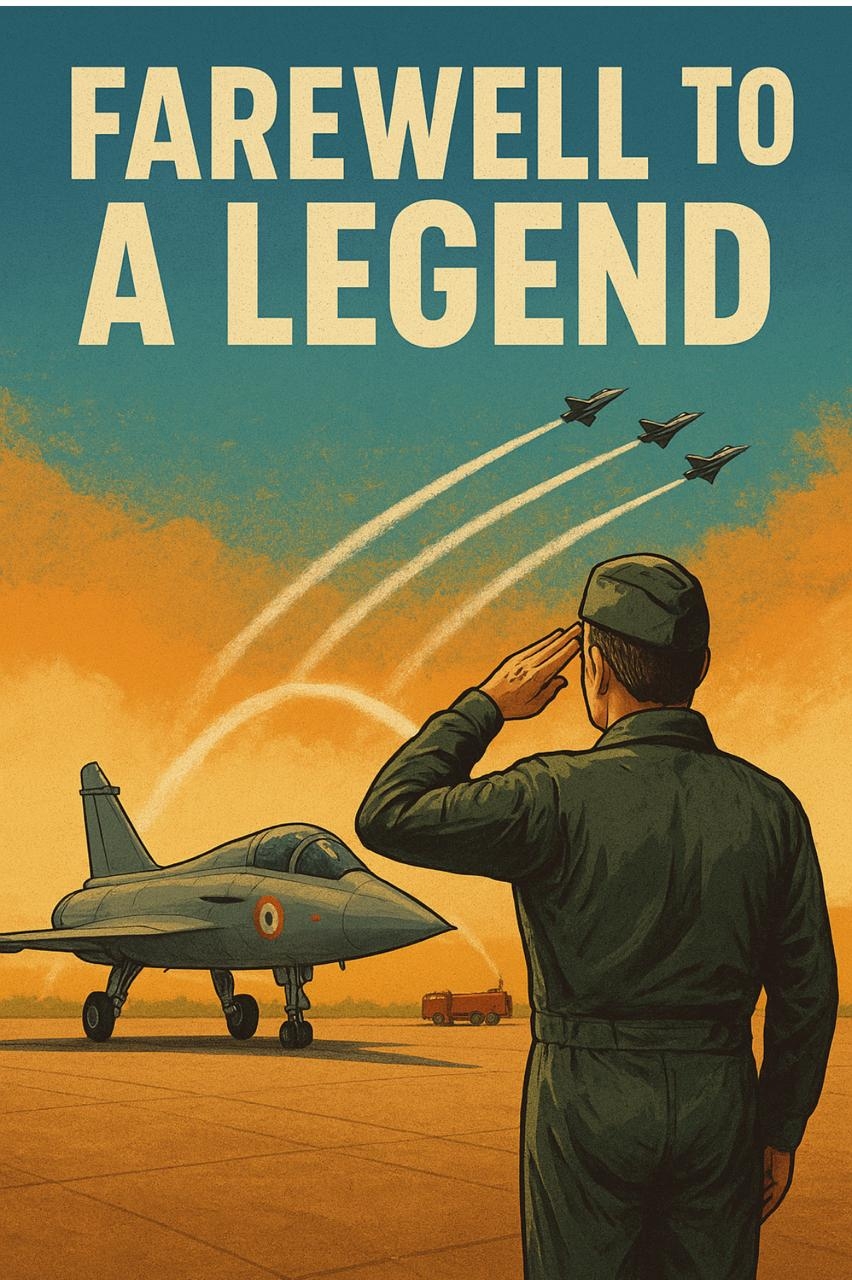
The world beyond the canopy stretched endlessly, the snow-capped shoulders of the Himalayas tapering away into a haze of brilliance. My MiG purred at altitude, obedient after her bursts of raw savagery. The adrenaline of loops and rolls lingered in my veins, but now the time came to return her home — to bring her back safe, as promised.
I thumbed the comm switch. “ Tezpur Tower, FlyBoy-One, overhead Delta Sierra , angels one-zero, request recovery .” A burst of static, then the calm professional voice of Air Traffic Control : “FlyBoy-One, Tezpur Tower. You are identified. Report initial runway three-one, left-hand circuit. Winds calm, QNH one-zero-one-three, surface visibility ten kilometres .” I read back, voice clipped but steady. “Copy, Tower. Initial runway three-one, left-hand circuit. QNH one-zero-one-three. FlyBoy-One.” With a gentle pressure, I brought the nose down, the Tumansky answering with a muted growl as the jet sliced through thin, icy blue into the denser air below. The altimeter unwound; the Brahmaputra widened beneath me, a silver serpent reflecting shards of the noonday sun. Villages dotted its banks, their tin roofs sparkling like signal mirrors.I eased her left, intercepting the circuit .“Tower, FlyBoy-One, initial runway three-one, one-thousand feet.” “FlyBoy-One, Tower, roger. Break left. Call finals.”
I rolled into the break, the harness biting into my shoulders as the horizon swung. The MiG bled speed obediently, her delta wing carving the air with a hiss. Power to idle. Airbrakes out. G-forces pressed me into the seat, but I felt nothing except the bond between my right hand and the throttle, my left on the stick.Downwind leg. Flaps selected. The aircraft trembled, nose dipping slightly — like a beast reluctant to slow down.“Gear down.” The cockpit answered with a satisfying thud, three greens glowing on the panel.“Tower, FlyBoy-One, downwind, gear down, full stop.”“FlyBoy-One, Tower, cleared to land runway three-one. Winds calm. Check wheels down.”“Three greens,” I whispered to myself — ritual affirmation.Base turn. My eyes flicked rapidly: airspeed, sink rate, alignment. The Brahmaputra slid off the right wingtip, tea gardens flashing beneath. My throat was dry, but the motions were instinct now, drilled into muscle memory.“Turning finals.”The runway rose ahead like a dark grey dagger in the greenery, heat shimmer blurring its edges. I trimmed, centered the needles, coaxed the throttle with tiny movements. The MiG’s nose bobbed slightly, alive, fighting me just enough to remind me she wasn’t a docile machine but a proud warrior returning from battle.“FlyBoy-One, cleared to land. Winds calm.” “Cleared to land, FlyBoy-One.”Over the threshold. Eyes locked on the far end. Throttle easing back. A hiss as the tyres kissed concrete — one bounce, then she settled, the delta wing clawing at the air before surrendering. The roar transformed into a rolling rumble through the undercarriage. Speed brakes out. Nose down gently. Parachute handle pulled — a violent jerk as the drag chute blossomed behind, the deceleration pressing me forward against the harness. The MiG slowed to a dignified trot, canopy reflecting streaks of sunlight.“Tower, FlyBoy-One, runway vacated. Chute jettisoned.” “FlyBoy-One, Tower, copy. Taxi to dispersal. Welcome back.”
I exhaled slowly, only then realizing I had been holding my breath. Taxiing back, the aircraft felt lighter, almost content. Ground crew figures grew larger, marshalling me with their practiced choreography.Canopy cracked open, a blast of humid Tezpur air flooding in. The scent of avtur and scorched rubber filled my lungs — perfume of the aviator.As I shut down, the Tumansky spooled down reluctantly, turbine whine fading into silence. A hand slapped the fuselage just below my cockpit — Crew Chief Ramesh. His face was expressionless, but his eyes carried the quiet pride of a craftsman whose creation had returned whole.I popped the harness and slid out, boots finding the ladder rungs. The ground felt unsteady after the sky, but Ramesh steadied me with a firm grip“Good sortie, sir,” he said simply.I looked back at the MiG, her paint scuffed, her intake dark as ever, as if she were still breathing. The bond was sealed now — man and machine, united by ritual, trial, and trust.The words of my Flight Commander echoed again: Respect the machine, and she will respect you.On the dispersal line at Salonibari, beneath the wide Assam sky, I finally understood.
The MiG rested, ticking softly as her metal skin shed the heat of flight. A faint shimmer rose from the fuselage, as if the aircraft herself exhaled after carrying me skyward. I stood on the tarmac, helmet under my arm, the world suddenly deafening in its silence.For a long moment, I couldn’t move. My gloves were damp, my heart still thundering, yet there was an emptiness inside me — as though some vital part of me still circled above the Brahmaputra, reluctant to come down.Crew Chief Ramesh broke the silence with his usual gruffness. “How was she?” His hand, still gloved and greasy, patted the MiG’s flank like a farmer patting his bull.I swallowed. My throat was raw from breathing pressurized oxygen, but the words came, soft. “She flew like… like she was alive.”Ramesh nodded, no surprise in his eyes. “She is, sir. She always is.”I turned back to look at her — squat, angular, unromantic in the eyes of those who had never flown her. But to me she was poetry in titanium. She had tested me, wrestled me, yielded only when I respected her limits. That was no mere flight. It was a dialogue, whispered at Mach speeds, sealed in G-forces and the edge of fear.The dispersal line buzzed now, young airmen swarming with checklists, fire trucks idling, the tower watching. Yet in that moment, the world narrowed — just me, the MiG, and the echo of her engine still drumming in my ribcage.
I thought of the rooftops of Guwahati where my boyhood eyes had once traced contrails, dreaming of this very day. I thought of my Flight Commander’s voice — Respect the machine, and she will respect you. I thought of the men whose portraits hung in the squadron briefing room, pilots who had taken this same leap and not all returned.And suddenly, the weight of what had just happened settled upon me.My hands trembled. Not from fear — but from awe. I had crossed the invisible threshold that divides a student of flying from a bearer of the warrior’s covenant. That flimsy clipboard and signature in blue ink had been transformed, through fire and sky, into something eternal.I placed my palm on the warm metal skin of the MiG, just behind the cockpit. For an instant I swore I could feel a pulse beneath it, steady and strong.“Thank you,” I whispered.Ramesh pretended not to hear, but his eyes softened.The ATC frequency still crackled faintly in my ears, the chatter of others going about their routine — incoming traffic, training sorties, tower clearances. Ordinary words. Yet to me, they sounded like a chorus, a reminder that I now belonged to that rhythm.
As I walked back toward the crew van, helmet dangling by its straps, the runway shimmered behind me in the heat. The mountains to the north stood sentinel, eternal witnesses to this fleeting human triumph.I knew life would never feel the same again. There would be harder flights, more brutal missions, darker skies. There would be risks, accidents, funerals. Yet this first solo was mine alone — a sacred pact signed in sweat, steel, and sky.And though the years ahead would test me in ways I could not imagine, I carried within me the certainty that I had found my place.High above Salonibari, in that slice of heaven where earth and sky meet, I had been reborn — not just as a pilot, but as a guardian of wings.The Assam dusk fell quickly, as it always did — one moment a molten red sky over the tea gardens, the next a velvet darkness pierced by the hum of cicadas. By the time I stepped into the Officers’ Mess, the air outside had cooled, carrying with it the sweet, damp scent of earth after sunset.
Inside, the Mess was alive. Polished teak tables gleamed under yellow light. The familiar crackle of ceiling fans mixed with the low murmur of voices, punctuated by bursts of laughter and the clink of glasses. On one wall hung photographs — stern faces of past squadrons, men whose flights had carved the lineage we now carried. Beneath their watchful eyes, life unfolded as it always had: young pilots being tested, veterans keeping tradition alive, all bound by the unspoken oath of the blue uniform.I walked in still feeling the weight of the helmet bag on my shoulder, though it held nothing now. Heads turned. Someone noticed first.“There he is!”A cheer rose, half-mocking, half-respectful. Flight Lieutenant Karan, one of the more senior QFIs, waved a glass dramatically. “Make way, gentlemen — the solo king has returned!”I felt my cheeks flush, heat rising despite the cool air-conditioning. “Easy there,” I said, trying to sound casual.But there was no escape. In seconds I was surrounded — claps on the back, firm handshakes, a mock bow from one of the younger pilots. A glass of beer was thrust into my hand before I could protest.“Speech!” someone called from the corner.“Not yet,” another voice cut in — Wing Commander Arvind “Sentinel” Kapoor himself, stepping forward with that quiet authority that could silence a room without ever raising volume. His eyes, sharp and steady, found mine. “First, let him breathe. He’s earned that.”The crowd softened, dispersing into small groups again, though not without grins and winks sent my way. I followed Sentinel to a corner table where a few senior officers sat, their presence commanding respect without effort.“So,” Sentinel said, leaning back in his chair, a glass of rum cradled in his hand. “Tell us — how was she?”My voice faltered. “She… she felt alive, sir.”A murmur ran around the table, approving smiles exchanged. One of the old Squadron Leaders, moustache bristling, chuckled. “Good answer. That’s the truth of it.”I tried again, more certain this time. “She tested me every second. She didn’t give me anything for free. But the moment I stopped fighting her and started… listening… she gave herself to the sky.”For a moment, silence hung heavy, not of discomfort but of recognition. Every man there had lived that same revelation.Sentinel nodded slowly. “And did you respect her?”The words hit with the weight of a hammer. The very same words he had spoken to me on the first day.“Yes, sir,” I said, my throat tightening. “With everything I had.”The room seemed to exhale as one. Glasses were raised, and someone signaled to the steward. Soon plates of steaming pakoras and peanuts appeared, their aroma filling the air, accompanied by the sharper scent of whisky and rum.Around me the night unfolded in its rhythm: the younger officers teasing, laughter breaking out in spurts, a pilot reciting an exaggerated tale of a near-miss over the Naga Hills, met with groans and claps. The baritone hum of Assamese folk music drifted faintly from a radio in the anteroom.
But beneath the laughter was something else — a current I could feel but not name. Pride, yes. Brotherhood, yes. But deeper still: the quiet knowledge that each man in that room carried his life in his hands every time he strapped into his cockpit. That tonight’s merriment, tomorrow’s sortie, the mess bills and inside jokes — all of it existed under the shadow of risk. And it was precisely that shadow which made the bond unbreakable. Karan leaned across the table, raising his glass toward me. “You know, tomorrow the glamour fades. The check rides, the endless debriefs, the chewing-outs from Sentinel here.” He grinned. “But tonight? Tonight, you’re one of us.” The others echoed the toast. Glasses clinked, amber liquid catching the light. I lifted mine with trembling fingers. The beer was warm, bitter, perfect. It burned down my throat like a ritual sacrament, binding me into the tribe of men who lived and died on wings. Much later, as the night thinned and the conversations softened into low voices and cigarette smoke curled in the corners, I stepped outside. The mess lawn stretched before me, lit faintly by lanterns. The stars were sharp above, unmarred by city glare, the Milky Way a pale river across the heavens. I tilted my head back, and for an instant I swore I heard again the thunder of the Tumansky, felt the stick in my hand, saw the Brahmaputra glinting like silver. My heart swelled until it ached. This was not just flying. This was not just a career. It was something deeper, older — a covenant between sky and soul. Behind me, laughter spilled again from the mess, reminding me I was no longer alone in this journey. Ahead of me, the dark silhouette of the hangars waited, and beyond them the runway stretched like a promise.I whispered to the night, to the MiG, to the brotherhood I had just joined:“I’ll never let you down.”And in the silence that followed, the stars themselves seemed to nod in answer.
Ambala. Evening. The sky is the same shade of burning orange I remember from Tezpur, though years — decades — stand between that boy and the man I am now.
I sit in my office, the glass windows looking out over the runway, where Rafales glint like crouching panthers, their canopies catching the last light of day. Behind me hangs the squadron crest of the Heritage Flight Wing, a unit born not just to fight, but to remember.I am Group Captain now. Commanding Officer. The younger pilots call me Sir with a mixture of respect and distance, and sometimes — though never in front of them — it makes me smile. They see the ribbons on my chest, the silver in my hair, the weight of years in my gaze. But they cannot see the boy from Guwahati rooftops who once dreamed of touching the contrails. They cannot see the young Flying Officer who whispered “thank you” to a MiG’s metal skin after his first solo.
Time hides those things. But I remember.
In a corner hangar at Ambala, the heartbeat of memory still lives. Two MiG-21s, painstakingly restored, kept pristine, not museum pieces but flyable, breathing machines of steel and spirit. They are flown only on anniversaries, parades, and days when the past demands to be honoured.
One of them — a MiG-21 Bison Tail Number — AT-1761.
I run my hand across her flank sometimes when I visit the hangar. The paint is flawless now, the metal gleams, but I can still feel the scars beneath, the battles fought, the sorties flown. She was mine once — not by ownership, but by covenant. I flew her more times than I can count, long before I graduated to the MiG-29, then the mighty Su-30MKI, and finally to the Rafale that now bears my name stencilled beneath its cockpit.AT-1761. She was the one who carried me through weather that tore at wings, through intercepts where seconds meant life, through circuits where fuel was a prayer whispered to the gods. She was the one who turned my fear into discipline, my youth into steel. And now she waits, dignified, like an aging warrior who still fits into her battle armour . Sometimes, when the airfield is quiet and the day’s flying has ended, I walk into that hangar alone. The lights overhead cast a golden sheen across her delta wing, and for a moment the years collapse. I see myself again, twenty-two, climbing the ladder with my heart pounding, Ramesh’s voice barking below, the canopy closing me into the small cathedral of speed and fire.
I touch her warm metal and whisper the same words I spoke then: thank you.And the tears come, unbidden, hot, and unstoppable. For in her reflection I see not just my youth but the faces of friends who never returned. Their laughter still echoes in mess halls now silent. Their callsigns still live on the squadron walls. In AT-1761’s polished skin I see them all — frozen in the sky where they belong .I command Rafales now. Sleek, powerful, Fly By Wire, 4.5 Generation State of the Art Fighter jet. forgiving in ways the MiG never was. I look at my young pilots strapping into them, full of bravado and hope, and I know they cannot yet understand the weight of this calling. One day they will. One day they, too, will look back with tears.
Perhaps in a few years I will hang up my G-suit for the last time. Retirement — the word tastes foreign, almost unreal. To walk away from the runway, from the smell of avtur, from the chatter of ATC and the roar of afterburners — how does one surrender a life lived on the edge of sky? But if that day must come, I will face it as I faced every sortie: head held high, heart steady. For I know I was part of something greater than myself. When I go, I want to be remembered not by the rank on my shoulder or the medals in my cabinet, but as a pilot who kept the covenant — who respected the machine, and was respected in return. And perhaps, on some special morning after I am gone, when the sun lifts over Ambala and the bugles sound, AT-1761 will roll out again. Her wheels will kiss the runway, her Tumansky will roar, and for a brief moment the sky will open as it once did for me .And in that sound, somewhere between thunder and prayer, my soul will fly once more.
For I was never just a man. I was a pilot. And I belonged to the wings.
A FEW YEARS LATER
The morning air at Ambala carried the crisp bite of Punjab’s winter, sharp enough to sting the lungs and awaken even the weariest soul. A thin veil of mist clung stubbornly to the runway, curling and dissolving in golden threads as the first rays of the sun crept over the horizon. The familiar ramp — the heart of the station — was alive with its daily rhythm: ground crew moving in well-rehearsed patterns, vehicles trundling in measured haste, engineers with their clipboards bent over checklists. Yet beneath the routine thrum, there was something different, something unspoken.A hush lingered beneath the bustle, a quiet reverence that everyone felt but no one voiced. It was the silence that comes when all present know that this morning is not like the others. That today, history and memory are converging.
Because today was my final flight.The final flight of an Air Commodore.
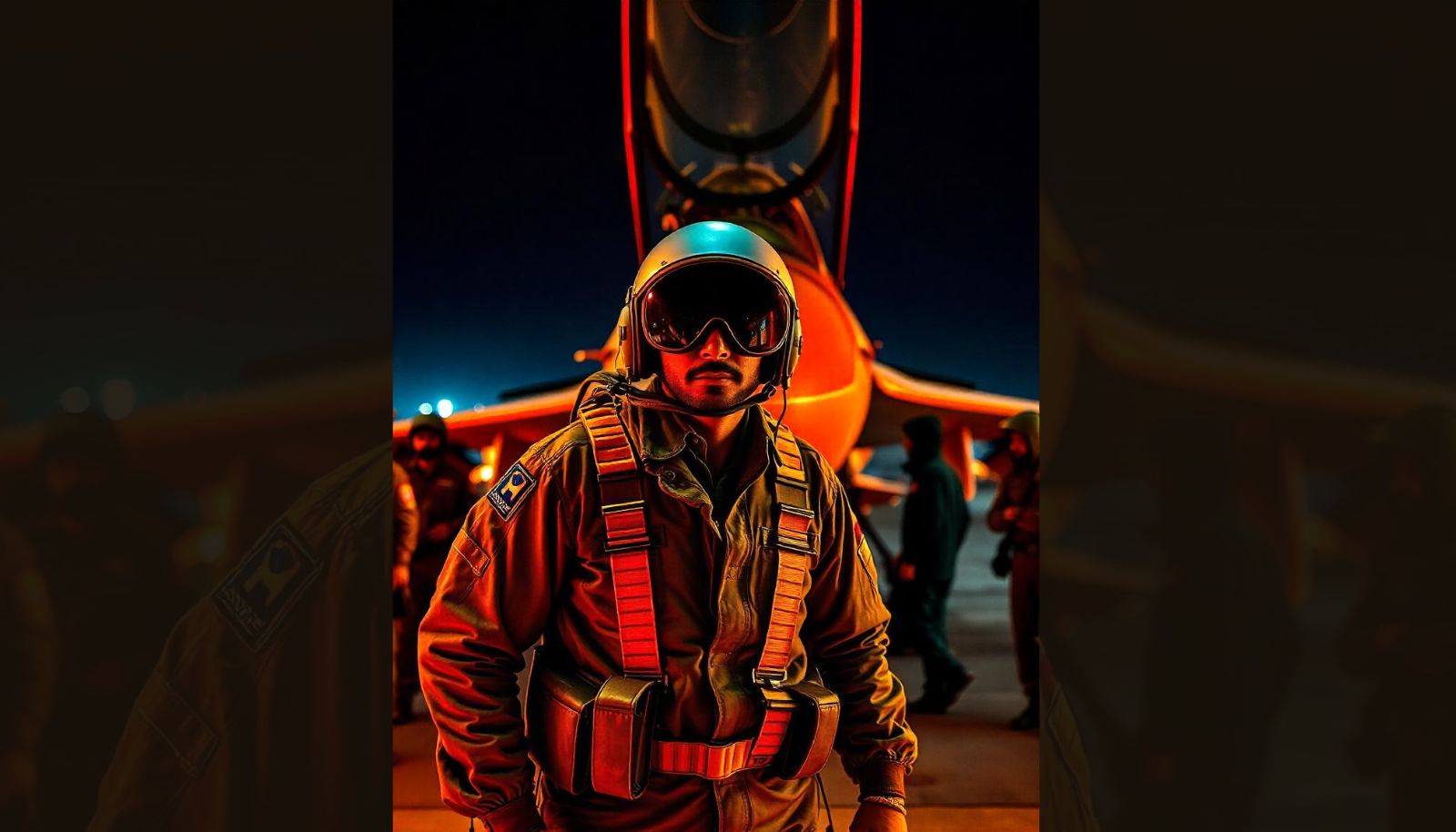
I paused at the threshold of the crew room, gloved fingers brushing the doorframe, heart hammering with a strange mixture of pride and grief. Behind me stretched a lifetime; ahead lay the short walk to the dispersal, to the waiting jet, to goodbye. I dressed slowly, deliberately, as though each piece of gear were part of a sacred ritual. The olive-green G-suit, snug and familiar, slid over me like a second skin. I had worn a hundred of them through the years — at Tezpur, Gwalior, Bareilly, Pune — but this one seemed heavier, weighted by memory rather than fabric. I pulled the zippers carefully, fingers lingering on the patches stitched into the cloth, each one telling a story, each one earned with sweat and sky. The helmet sat on the bench beside me, visor gleaming faintly under the fluorescent light. I ran my palm slowly over its curve, tracing the scratches that bore silent testimony to the sorties it had seen, the lives it had sheltered. To anyone else it was just a shell of composite and glass. To me, it was a crown — the final crown I would wear before the sky claimed me one last time.